Europe Prepares to Spend €800bn in Military Spending

A recent meeting between US President Donald Trump and Ukrainian President Volodymyr Zelensky underscored growing uncertainty over US military aid to the conflict in Europe.
While discussions centered on continuation of military aid and potential peace negotiations, the outcome left European leaders considering the need for greater defense self-sufficiency.
Shifting support: Earlier this month, Donald Trump and Volodymyr Zelensky met to discuss the potential outcome and solution regarding the conflict between Ukraine & Russia.
- It was meant to reaffirm US support for Ukraine including peace negotiations and mineral deals, but instead the meeting ended in a sour note between the two leaders.
- President Trump reportedly pressed President Zelensky to consider diplomatic negotiations with Russia, emphasizing the need for a ceasefire, but was met with skepticism.
- The debate during the meeting was tense, where President Trump eventually signaled a possible shift in US policy, including a freeze on further military aid.\
- In December 2024, United States allocated around USD120bn in aid to Ukraine, which was around 40% of the total aid for the country throughout the year.
Military self-sufficiency: Acknowledging the need for stronger security measures, EU leaders have committed to a multiyear defense spending strategy aimed at reinforcing military capabilities
- The European Commission has proposed up to EUR150bn joint borrowing in the near-term to fund military investments through a new program called European Peace Facility (EPF).
- The estimated total cost for the military spending could reach as high as EUR800bn over the next 4 years, assuming all states increase defense spending by an additional 1.5% of GDP.
- A shift toward military self-sufficiency is underway, with France, Germany, and Poland leading these efforts to develop independent defense capabilities.
- Even the UK, which is not part of EU, has maintained commitments to European security co-operations.
Source: Algo Research, Stockholm International Peace Research Institute (SIPRI)
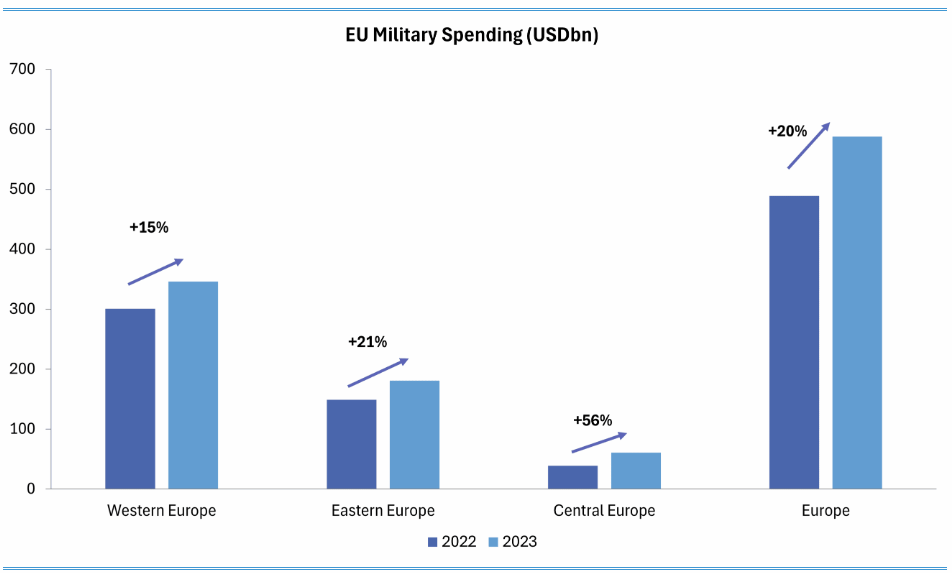
Gearing up: Defense budgets across the regions have been increasing since the Ukraine-Russia conflict started, with some member states already spending 2% of their GDP.
- Total military expenditure in Europe increased by +20.3% YoY in 2023 to a combined value of USD588bn from USD489bn in the previous year.
- By regions, Western Europe military spending grew by +14.9% YoY to USD346bn that include countries like France and Germany. Eastern Europe grew by +21.7% YoY to USD181bn including border security and cooperation by Baltic nations.
- Central Europe grew by +55.8% YoY to USD61bn driven mainly by Poland, Czech Republic, and Slovakia, which are nearest to Ukraine.
Potential escalation: In the absence of U.S. military aid, continued European military spending raises concerns whether it could escalate the conflict rather than aiming for peace or negotiations.
- While the probability of a full-scale conflict between EU and Russia remains low, the ongoing arms buildup and absence of meaningful negotiations increase the risk of prolonged instability.