Buffett-backed trading houses target double-digit ROEs, above Japan’s average
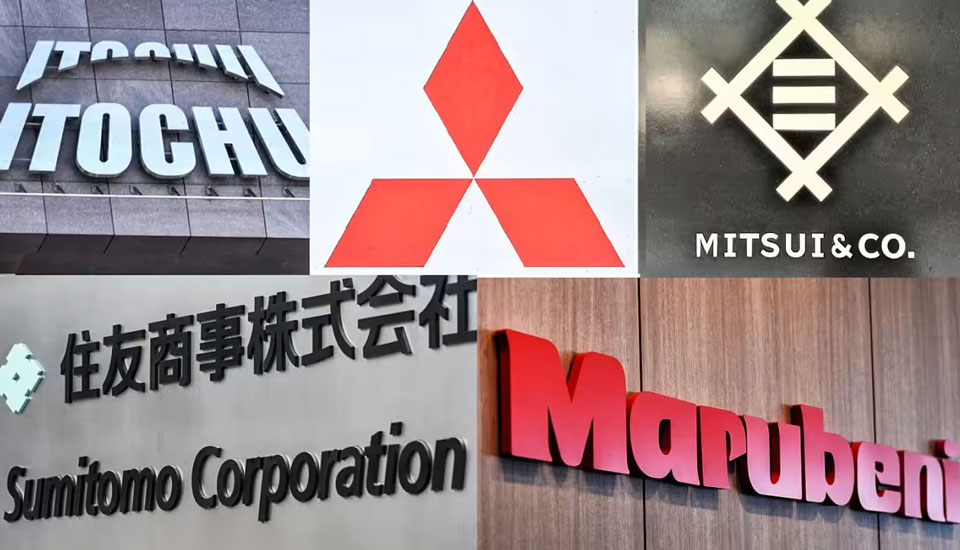
Japan’s major trading houses are aiming for double-digit returns on equity (ROE) by revising their portfolios to raise profitability and distributing cash to shareholders, putting their targets for capital efficiency above the national average of 9.7%.
Mitsubishi Corp., Itochu, Mitsui & Co., Sumitomo Corp. and Marubeni held earnings conferences this month, each stressing their efforts to improve profitability and promising shareholder returns. The five trading houses have been attracting market attention since Warren Buffett-led Berkshire Hathaway disclosed its investments in them in 2020.
Their targets are a 16% net profit for Itochu, 15% for Marubeni, 12% for Sumitomo and 10.4% for Mitsubishi for fiscal 2024, ending next March. Although Mitsui did not disclose its outlook, the indicator was 15.3% for fiscal 2023 and chief executive Kenichi Hori said at a news conference that it “will continue to pursue management aimed at improving ROE and corporate value” for fiscal 2024.
The sector’s ROEs are higher than the 9.7% average for companies listed on the Tokyo Stock Exchange’s Prime market, as estimated by Nikkei for fiscal 2023, but still way lower than the 40% average for the world’s top 100 companies by market capitalization, leaving room for further improvements to raise capital efficiency.
The companies previously benefited from spikes in commodity prices, which pushed up their profits to record highs in fiscal 2022. With commodity prices now moderating, the companies need to revise their portfolios to maintain the same levels of profitability.
| Trading houses target double-digit ROE in fiscal 2024 | ||
| Net profit
(In billions of yen) |
Return on equity
(In percent) |
|
| Mitsubishi Corp. | 950 | 10.4 |
| Itochu | 880 | 16.0 |
| Mitsui & Co. | 900 | 15.3 |
| Sumitomo Corp. | 530 | 12.0 |
| Marubeni | 480 | 15.0 |
| *Company estimates for fiscal 2024 except Mitsui’s ROE, from fiscal 2023 | ||
In fiscal 2023, net profit dropped by 5.9% for Mitsui, 18.4% for Mitsubishi and 13.2% for Marubeni, though it remained at high levels: respectively 1 trillion yen ($6.4 billion), 964 billion yen and 471 billion yen. Itochu’s profit increased slightly by 0.2%, supported by food, information technology and retail businesses.
“We are replacing assets under criteria such that it is better to exit before the end of the lifespan of assets that would become stranded,” Mitsubishi’s CEO Katsuya Nakanishi told reporters last week.
Mitsubishi’s revenue from asset sales for fiscal 2023 was the highest in five years at 760 billion yen. Looking ahead, the sale of its Australian coking coal mine will be among the factors supporting fiscal 2024 profit, which the company projects to decline by 1.5% from the previous year.
The company is eyeing new investments in copper projects as part of the global energy transition as well as acquisitions in Western markets, Nakanishi said.
Likewise, Mitsui generated 537 billion yen in cash through asset sales in fiscal 2023. In fiscal 2024, the sale of its interest in Indonesia’s Paiton coal-fired plant and the Brazilian logistics operator VLI will contribute to net profit, though this is estimated to decline by 15.4%.
Marubeni’s profit is expected to rise by 1.8% in fiscal 2024, supported by growth in its non-commodity businesses and its investment in the Los Pelambres copper mine in Chile. Since commodities such as metals and energy are prone to price volatility, “our aim is to grow the non-commodity chunk as much as possible” from the current profit of about 300 billion to 400 billion yen, said CEO Masumi Kakinoki.
Itochu’s profit for fiscal 2024 is expected to rise by 9.8% to 880 billion yen. President Keita Ishii said on Wednesday that he expects its existing investments to generate profits, including the IT business Itochu Techno-Solutions and renewable energy in North America. Regarding new investments, he named consumer businesses, digital transformation and generative AI as possible areas for its investment budget of up to 1 trillion yen.
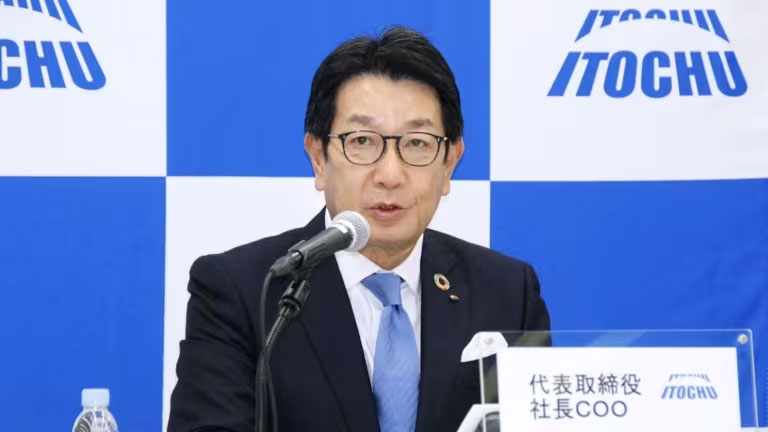
Itochu President Keita Ishii speaks at a news conference on May 8 in Tokyo. The company’s profit for fiscal 2024 is expected to rise by 9.8%. © Kyodo
Sumitomo’s profit dropped by 31.6% to 386 billion yen, lower than its previous forecast of 500 billion yen, dragged down by losses from businesses including the Ambatovy project for nickel mining and refining in Madagascar and telecommunications in Myanmar. Sumitomo expects its profit to rebound by 37.2% in fiscal 2024 to 530 billion yen.
Asked whether Sumitomo would consider pulling out of the Ambatovy project, CEO Shingo Ueno said, “It is our top priority to repair the [glitches in the] plant and recover production,” adding that once production is back in place, “we would consider all options on the table.”
In addition to improving profitability, pushing up ROE involves distributing excess cash to shareholders. All of the five companies look to raise annual dividends for fiscal 2024 under a progressive dividend system — meaning dividends can only remain at the same level or go up.
Sumitomo became the last to adopt the progressive dividend system. Its previous system, based on the dividend-on-equity ratio, was “difficult to understand [for investors], and we were the only trading house not adopting progressive dividends,” said Ueno. The company has set a target of a 40% payout ratio in its midterm plan through fiscal 2026, “indicating our confidence for further growth,” according to Ueno.
Analysts have been looking at payout ratios as the key factor for pushing up the sector’s share prices. Most of the companies have announced share buybacks: 200 billion yen for Mitsui, 150 billion yen for Itochu and 50 billion yen each for Sumitomo and Marubeni. Mitsubishi said it would consider buybacks according to its cash flow.